Monday, March 25, 2019

Coaching and Life Lessons from Amelie


A little thing happened since we last chatted…


Just when we were starting to think that Amelie was going to scoot across the stage to receive her high school diploma, Amelie proved yet again, that she marches to the beat of her own drummer not ours. In doing so, she taught me a valuable lesson about motor learning that greatly impacts how I engage in this process in the clinic.

**Special thanks to Joe Hannigan (Skyline's student-extraordinaire) who helped lay the foundation for this blog post with his incredible motor learning in-service!

10,000 Foot View:

What is motor learning? Motor learning is a relatively permanent change in the ability to execute a motor skill as a result of practice or experience1. In our Amelie case study, the motor skill of interest is walking.

Amelie (and Joe) helped me realize that there are 3 crucial tenets of motor learning that must be addressed in order to achieve a successful outcome: salience, specificity, and intensity2.

1. Salience – importance to the person. Amelie was not going to engage in the process of learning to walk unless she found it important to her. Judging by the look on her face while scooting, she was in no rush to give this form of locomotion up.
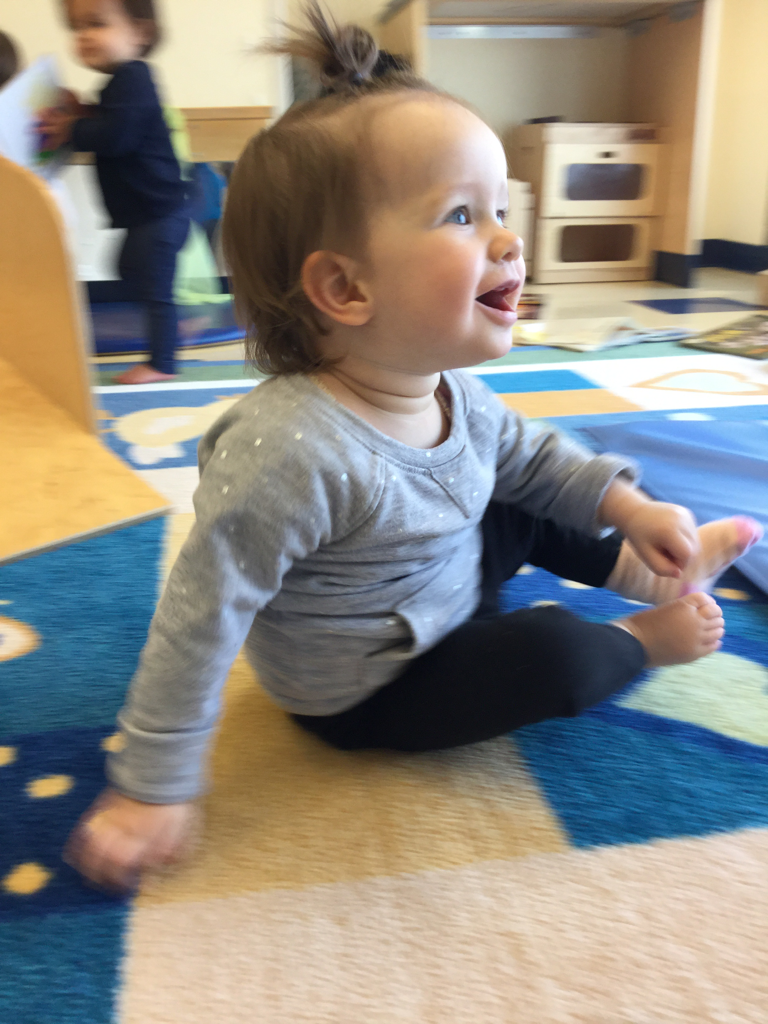

Salience is crucial. If the learner does not connect with the perceived importance of the task, then they will not be willing to put in the work (and it is a lot of work) to master the skill.

2. Specificity – the proverbial steps on the journey to walking must be specific to the end goal – walking – not scooting, not crawling, not climbing. No matter how beneficial these tactics might be in the development of strength, mobility, and endurance (more on these to come), task specificity is walking.

3. Intensity – motor learning requires the learner to push themselves out of their comfort zone, over and over again.

Precursor to motor learning:
Capacity (mobility, strength, endurance) is a precursor to motor learning – establish capacity first3. Or, in the words of our fearless leader, Richard Jackson: Stretch -> Strengthen -> Functionally Retrain.

Even if Amelie decides that it is important to learn to walk, she must possess the requisite capacity to engage in the learning process.

I have spent a lot of time reflecting on capacity as a foundation for learning. What are the metrics that I can use to track mobility, strength, and endurance? Do these metrics directly relate back to the end goal of the motor skill? Remember, two of the keys to motor learning are salience (importance to the person) and specificity. If you are building a foundation of mobility, strength and endurance that is specific to the movement of concern and is important to the patient, you are on your way!

Low Hanging Fruit:

We can challenge intensity through4:

1. Feedback - How does Amelie know if she is improving her walking? The ideal feedback is dichotomous – easy to determine pass vs fail. In Amelie’s case, fail equals falling. Everything else is a pass. This feedback is immediate and specific to the task.

I am constantly working to improve the feedback I give my patients. Is my feedback something tangible for the patient (don’t fall) or is it some nebulous cue to engage some deep muscle that they cannot identify or pronounce, let alone engage? As the learner improves, you can alter the feedback to enhance learning. This can come in the form of reducing the frequency of the feedback, changing the input of feedback (visual cue vs auditory cue), or providing summative feedback rather than feedback in the moment - just to name a few. The iterations of feedback are endless, but I try to make sure the feedback is dichotomous and salient to the learner.

2. Weight – Amelie worked to modify weight by first walking with a rolling walker. 


As she becomes a more proficient walker, Amelie will begin walking while wearing a weight vest. What are we without progress :) ?

3. Environment – Early in the learning process, Amelie practiced walking in a controlled environment, where we could limit distractions and obstacles to her performance (our house). From here, she progressed to environments that were less controlled and had more potential distractions (daycare). Eventually, she progressed to chasing every dog in Shirlington Village, screaming “bow wow wow” and giggling with glee.

Remember – just because your patient performs a skill in the clinic, does not ensure the same success in the outside world. Practice in the environment in which they will have to perform.

4. Dual task – Involves divided attention in the performance of the skill. In Amelie’s case, this most frequently involves singing Baby Shark while pushing her walker.

5. Speed/accuracy – This was best tested through chasing our cats around the house. Can Amelie catch the cats? To do so, she needs speed. Can she successfully grab their tails? To do so, she needs accuracy. These are parameters of intensity that Rebecca does not support nearly as enthusiastically as I do. 

*Disclaimer – no cats were harmed in the making of this blog post.

6. Practice – Our method of exploration. Practice the task. Learn the limits of your capabilities and improve them. In the book Peak: Secrets from the New Science of Expertise, Anders Ericsson describes deliberate practice as the gold standard to building new skills and abilities.

What is deliberate practice? Practice that is purposeful and systematic. Deliberate practice demands near-maximal effort, which is generally not enjoyable. This goes back to the idea that you need the requisite foundational skills (mobility, strength, endurance) to even allow yourself to engage in deliberate practice. Additionally, deliberate practice depends on effective mental representations of the task - make it possible to monitor how one is doing. This is critical! What does successful performance look like? The answer should be clear and concrete.

7. Error – We learn through trial and error. Amelie did not read any books on the mechanics of walking (despite my encouragement to do so) or listen to my futile attempts to lecture her on the importance of walking. She learned to walk through trial and error (once she decided it was important for her to learn to walk). This also ties back to the point about feedback - The error with Amelie’s walking is a fall. Anything else is a success. This is a clear method for assessment, did I fall? Yes = fail. No = pass. Amelie does not need me to tell her if she passed or not. Your goal with any motor learning task is to set up a clear dichotomy of consequences – pass/fail.

What Did I Learn?

I cannot force motor learning. It is something that I can only nurture when Amelie is ready and when it is important to her. Thank you Amelie, for yet another incredible life lesson.


References:
1. Haibach-Beach P, Reid G, Collier D. Motor Learning and Development – 2nd Edition.
2. Motor Learning – An Application in the Orthopedic Setting. In-Service – Joe Hannigan, SPT – 3/19
3. Understanding Human Movement as a Dynamical System – Erik Meira (2018) – as part of the course: Complex Understandings for Simple Solutions
4. Mowder-Tinney and Streeter 2018: Translating Motor Learning into Practice: What is M.I.A. from your patient care?
5. Ericcson KA, Pool R. Peak: Secrets from the New Science of Expertise (2016)

Thursday, January 17, 2019

A Not So Tempo-rary Training Tactic


When you are raising an 18 month old that has discovered a new passion for climbing, you have to keep your head on a swivel! In the last two months, Amelie has decided that her life’s goal is to summit every cliff that stands in her way. Stairs? No problem. Windows? She’ll just use the couch as a step stool. Toilets? How about a muscle-up to get to the top?


Needless to say, I have been focusing all of my parenting efforts on speed-based, reactive training to keep up with Amelie. As a result, I have neglected slow, controlled movements in my fatherhood training.


Last month, when working with One Life Fitness trainer Evin Samuels, I had the pleasure of being reintroduced to this often overlooked training principle - tempo training. By and large, tempo is a component of strength training that gets neglected in the rehabilitation setting, in favor of the more common variables of frequency (number of times per week you train), duration (length of time you train), and volume (total number of repetitions completed in training).
What is tempo training, you ask? Great question!

10,000 FOOT VIEW: 

Tempo is the total length of time to complete an entire repetition1.  This is a hugely important variable because it dictates the amount of time that a muscle spends under tension during a strength movement. The more time under tension, the greater the potential to develop strength. Tempo can be broken down into four parts equating to each component of the strength movement, and is listed as a sequence of 4 numbers (ie 20X0). In order to demystify the sequence, let’s break down each of the numbers:

1. The first number (2 in our example) is always describing the length of time (in seconds) of the eccentric contraction – when the muscle is lengthening under the load. The PT community is fairly familiar with eccentric loading, especially with regards to the research by Alfredson on Achilles tendinopathy in 19982 (more on this topic later). Eccentric loading ensures body control through the movement’s entire range of motion and has been shown to increase type I collagen synthesis3 (building blocks of our connective tissue) and hypertrophy of muscle fibers. Utilizing a slower eccentric contraction can also be of great benefit to a person that is new to strength training because it helps them develop body control and provides a safety net against uncontrolled speed through the lengthening portion of the movement (which can place excessive stress on the muscle, connective tissue, and the joint).


2. The second number (0 in our example) is always describing the length of time (in seconds) of the pause in a stretched position. The pause in the stretched position demonstrates complete control of the movement, as it requires muscular control/stability at the position of extreme length. Muscular control/stability in end range lengthening is crucial for everyone, especially our hypermobile patients that too often rely on locking out their joints to achieve stability in end range positions.


3. The third number (X in our example) is always describing the length of time (in seconds) of the concentric contraction – when the muscle is shortening under the load. The concentric phase of the movement is often designed to be a speed based phase. When you explosively move through the concentric phase, you increase the percentage of motor units within a muscle recruited for the movement. This explosive movement would be described as (X) in our sequence. The concentric portion of the movement is the only portion where you would move as quickly as possible (X). When working with patients with muscle/tendon injuries, using a slower concentric phase can be a safe way to initiate a strength foundation, while working towards an explosive concentric contraction (X).


4. The fourth number (0 in our example) is always describing the pause in a shortened position. The pause in the shortened position is also important to demonstrate complete control of the movement. The late, great strength coach, Charles Poliquin recommended pauses in this position to increase fast twitch muscle fiber recruitment during the lift4. Keep in mind, the pause is only effective for muscle fiber recruitment if it does not involve locking out in a rested position (ie locking out your arms at the top of the bench press). Think about a pause at the end of your pull on a row or a pull up – this position does not involve locking out the joint and keeps you under muscular tension during the pause.


 LOW HANGING FRUIT:

Now that we know what tempo is, we should discuss who can benefit from tempo training. The short answer is - any patient that you deem safe to participate in strength training. We already mentioned that tempo training can be beneficial for our hypermobile patients to improve muscular control/stability in end ranges. Additionally, our patients that are new to strength training can use tempo training to develop better body control. Patients with muscle strains can use longer duration repetitions to slowly build load to the healing muscle and progress towards speed tolerance as the strain heals. What about two of the most common soft tissue conditions we see in the clinic - pain associated with tendinopathy and pain associated with soft tissue stiffness?

Good news! Tempo training can be beneficial in these populations, as well! O’Sullivan et al concluded that eccentric loading increases tissue length and joint range of motion, in addition to improving muscle strength5. 

With regards to tendinopathy, the times they are a changing! Gone are the days of using Alfredson’s2 “eccentrics only” protocol to treat tendinopathy. What has replaced it? Tempo training! Malliarias et al conducted a systematic review on loading programs for Achilles and Patellar tendinopathy and found that heavy slow resistance training (a synonym for tempo training) has a greater positive effect on tendon adaptation and remodeling than “eccentric only” training7. Tempo training was also associated with greater evidence of collagen turnover when compared with “eccentric only” training7.

To get you started on your tempo training journey, I have included some sample tempos for different categories of patients.

Hypermobile patient: 3110 – The focus with this group is on the eccentric phase and a pause at end range to ensure control through their entire range of motion.

Novice strength training patient: 3020 – The focus with this group is on control through both the eccentric and concentric phases in order to improve body control.

Muscle strain patient: 4020 – The longer time under tension will allow for a focus on control without overloading on weight or speed of contraction. This can be progressed to a 20X1 when the muscle strain has reached the later stages of rehabilitation.

Tendinopathy – 3030 – Heavy slow resistance throughout the entire repetition is the name of the game with this group.

Stiff patient – 8210 – The focus in this group is time in the eccentric and fully stretched position.


WHAT DID I LEARN?

There are a myriad of benefits associated with tempo training, across a wide spectrum of backgrounds and training levels. Now, if I can only get Amelie to buy in to the benefits of slow, controlled movements.
Stay tuned.

*** Side note – if you work in a clinic attached to Sport & Health/One Life Fitness, please connect with their training staffs! They are incredibly talented coaches/trainers and I have learned so much from observing them coach, chatting with them about mutual clients, and now training with them – shout out to Evin Samuels for the inspiration behind this blog post!


References:
1. Charles Poliquin - Poliquin Principles: Successful Methods for Strength and Mass Development – 1997.
2. Alfredson H, Pietilä T, Jonsson P, Lorentzon R. Heavy-Load Eccentric Calf Muscle Training For the Treatment of Chronic Achilles Tendinosis. Am J Sports Med 1998 26: 360-366.
3. Eccentric rehabilitation exercise increases peritendinous type I collagen synthesis in humans with Achilles tendinosis. Langberg H, Ellingsgaard H, Madsen T, Jansson J, Magnusson SP, Aagaard P, Kjaer M Scand J Med Sci Sports. 2007 Feb; 17(1):61-6.
4. Charles Poliquin - Rep Tempo: An Essential Loading Parameter - https://www.strengthsensei.com/rep-tempo-essential-loading-parameter/
5. O'Sullivan K, McAuliffe S, DeBurca N. The effects of eccentric training on lower limb flexibility: a systematic review. BJSM Volume 46, Issue 12; 2012.
6. The Shoulder: Complex Understandings for Simple Solutions - Adam Meakins – 2018
7. Malliaras P, Barton CJ, Reeves, ND, Langberg H. Achilles and Patellar Tendinopathy Loading Programmes: A Systematic Review Comparing Clinical Outcomes and Identifying Potential Mechanisms for Effectiveness. Sports Med (2013) 43:267–286.


Tuesday, November 13, 2018

(Chronic) Stress, (Chronic) Stress, Go Away!


It is 7:14 pm on Thursday, November 8, and I have summited my Everest! I just completed my 50th book of 2018 and it has been a grueling and amazing journey! Rebecca can attest to the countless hours of audiobooks that have provided a cacophony of 1.5 x speed sounds in our home for the past year. Thank you Rebecca for staying with me in my sickness, as you promised in your vows.

I have spent the last weeks reflecting on the books I have read this year and a couple of things come to mind about my journey:

1. 50 books is a ton of freaking books! Especially for the kid that was bearish on reading after high school English class and the endless dissection (to a fault, in my humble opinion) of literature.
2. My mom is probably smiling as she reads this, and takes credit for the early nourishment of my reading habit through summer book reports.
3. Tracing the words with your index finger while you read is like reading at 1.5 x speed. I would still be plodding along through these books if I didn’t stumble upon this little trick.
4. Choosing a favorite book is like choosing a favorite pair of socks, I love them each for their unique attributes (not children – I find it hard to believe I could like or love another child as much as this little nugget)

 In my attempts to unsuccessfully choose a favorite book, I did decide on the book that had the greatest impact on my daily life. For this reason, I have decided to give you a book report on Why Zebras Don’t Get Ulcers. This one is for you, mom.

Have you ever noticed that the world seems more stressed these days? We all have a to-do list a mile long and 5 minutes to complete it. We wear our stress as a badge of honor, bragging to anyone who will listen how busy we are and how little time we have available to us. Chronic stress is all around us, and it sucks the energy right out of us. We see it in the clinic every day, manifesting in multiple body system impairments and increasing levels of musculoskeletal pain. You know who isn’t overly stressed or busy…Amelie! She wakes up each day with a smile that says, “Good morning world! What do you have in store for me today?” She wears that smile until the moment she goes to sleep, and it truly is infectious.

How can I bottle up that smile and take it with me as an espresso-shot of happy? This conundrum led me to my next book…

What exactly is the impact that stress has on the body? To find out, I decided to read Why Zebras Don’t Get Ulcers by Robert Sapolsky and it was an eye opening experience! Sapolsky is a neuroendocrinologist (super smart dude who studies the effects of hormones on the nervous system) who writes about the effects of chronic stress on everything in the body. He took me on a roller coaster ride as he beat me down for 17 chapters on how chronic stress is sucking the life out of each of the major systems in my body. He finished the book by restoring my hope for humanity with some actionable steps for how to combat stress and minimize its detrimental effects on the body. He discussed 2 processes for stress adaptation:

1.  Homeostasis – body tinkering on a structural level (tactics) to maintain the status quo
2. Allostasis – brain coordinating body-wide changes, often including changes in behavior (principles)

Naturally, we want to focus on allostatic responses – global responses that have the most bang for their buck! When in doubt, principles over tactics.

10,000 FOOT VIEW:

Acute stress response is a good thing and keeps us alive! The acute stress response is a physiological reaction that occurs in response to a perceived harmful event, attack, or threat to survival. Sounds pretty good, right? Lion chases after you in the Serengeti – mobilize stress response to kick the lion’s ass or run like the wind!

Chronic stress is a very bad thing and it is sucking the life out of us! You cannot fight/flee the lion all day/every day. What happens to the body when we are in a constant stress response? During chronic stress:

1. LDL cholesterol (bad) levels are elevated and HDL (good) levels are diminished
2. Elevated insulin levels in blood and insulin resistance in the body (diabetes)
3. Elevated systolic and diastolic blood pressure (heart disease)
4. Elevated glucocorticoid levels (stress hormone) block the uptake of dietary calcium and accelerate the resorption of bone (osteoporosis)
5. Chronic stress suppresses immune function (sick)
6. Elevated stress and glucocorticoids inhibits neurogenesis (growth and development of nervous system)
7. Less time spent in deep sleep (portion of sleep critical for restoration of new memories, consolidates information from previous day)

To sum up - Chronic stress is maladaptive and impacts everything in the body. How many of your patients present with 1 or more of the comorbidities mentioned above when they get referred to your clinic with low back pain?

We can fight the effects of stress by treating the symptoms (ie taking a pill to treat your stress-related illness). This homeostatic response is a good first step, but it is the equivalent of putting a Band-Aid on a cut after you fall. If you avoid the fall in the first place, you eliminate the need for the Band-Aid. Chronic stress is the proverbial fall that is scuffing our knees.

LOW HANGING FRUIT:

How do we combat stress? Follow this allostatic process!

1. Outlet for frustration – What is your go-to outlet? As a physical therapist, I strongly encourage people to use exercise as an outlet for frustration. The benefits of exercise are countless! It is beneficial for cardiovascular purposes (see my blog post on The One Minute Workout in Running Away From Running). It is even beneficial for mental and brain health purposes – check out the book, Spark by John Ratey to learn how he uses exercise as a treatment modality in his work as a psychiatrist. There are so many other great resources on the benefits of exercise - just ask me in the comments section!

2. Social support – we get this in PT, working with a trainer, and group exercise classes (to name a few). Don’t take your patients out of their group exercise classes! Let them continue to go to their CrossFit box – shout out to CrossFit Adaptation – because the stress outlet may be just as beneficial as the physical benefits from the WOD. Work with your patient to modify their group exercise classes, but avoid benching them, if at all possible.

3. Predictability – makes stressors less stressful – talk to your patients about the stressors in their lives. How do the daily Beltway commute and checking work email during dinner add stress to your patient’s day? Talk to your patients about the microstresses that accumulate into a stress cloud that follows your patients everywhere.

4. Control – This is where stress relief tactics can be a game changer! If you have a specific activity that you can employ to reduce your stress, now you have a sense of control. How can we address these stresses in the moment, in a predictable fashion to gain a sense of control? In addition to exercise (as mentioned above), Sapolsky talks about the benefits of meditation, and how it reduces glucocorticoid levels and sympathetic tone (stress markers) while you are meditating. I have been working to make meditation a morning habit for the past 3 years and can personally attest to the effectiveness of the following apps in my journey:

https://www.headspace.com/ This is a great app that provides guided meditation that is tailored towards different stressors in your life – stuck in traffic? There is a guided meditation for that. Nervous about a plane flight? Got that too. They even have meditation packs for things like anxiety, depression, undergoing treatments for cancer, and many others. To top it off, the guide Andy Puddicombe, is from the United Kingdom and has that sweet UK accent! This is a subscription based app (totally worth it) and it has a sample pack of 10 free guided meditations and video tutorials to improve your meditation experience.

https://www.oakmeditation.com/ This is a great app (and it’s free!) that gets to the heart of meditation – no frills, just 2 choices for guided meditation, 1 for unguided, and some breathing drills.

Disclaimer – I have no ties to either of these apps other than being a satisfied user of both.

5. Perception of things improving – It can be a challenge to see how chronic stress is improving on a short term basis. Our patients that have chronic pain go through the same struggles. Help your patients objectively track their stress relief tactics that will lead to long term changes in chronic stress (and pain for that matter). It helps if their tactics are goal oriented and the goals should be important to the patient. Whether they are exercising, meditating, or performing some other stress relief tactic, it is helpful to keep a log of the activity. Each week, there should be measurable changes towards the goal.

Here is a sample activity log taken from my interval training to complete my 10 mile trail race earlier this year (if you want to learn more, go check out my blog post Running Away From Running J):

Long Term Goal: Finish 10 mile trail race using high intensity interval training
Short Term Goal: Maintain speed of 29 mph on bike for 4 sets of 30 seconds
Activity: 4 x 30 second sprints on Airdyne (rest 2.5 minutes between sets)
Set 1 – 28.5 mph
Set 2 – 29 mph
Set 3 – 29 mph
Set 4 – 28 mph
Rating of perceived exertion – 8,9,9,10.
Set 1 – did not warm up adequately (early morning workout session and only spent about 2 minutes warming up on the bike)
Set 4 – I was spent – I could have used another 30 seconds of rest

The log can be as general, or specific, as you like. The key is that you are working towards a short term and a long term goal that you can objectively track.

WHAT DID I LEARN?

To combat chronic stress, be more like your children (before they were sent to high school English class)!


Monday, October 8, 2018

Confessions of a Podcast Addict


My name is Dan Alcorn, and I am addicted to podcasts. Just ask my wife, and don’t be alarmed by the reflexive eye roll. There is never a moment of podcast silence in our household. My podcasts come in all shapes and sizes – sports, politics, psychology, history, and my favorite, human performance. What better way to spice up your daily chores of making breakfast, packing lunches, cooking dinner? My podcast playlist has grown so long that I have adopted drastic measures to listen to them all…1.5x speed! Just when Rebecca thought I couldn’t find a way to make my podcast habit more annoying! Recently, I was listening to a podcast interview with the tendon guru, Jill Cook, which was a perfect supplement to a tendonopathy discussion we just completed in the Jackson Clinics Upper Extremity Athlete Fellowship (I never turn down an opportunity for a shameless plug of the Jackson Clinics Upper Extremity Athlete Fellowship). Look at this Mount Rushmore of Shoulder Nerds!


(If you would like more information on how to join this cast of misfits please reach out to me)

I digress.

In this podcast interview (Healthy Wealthy & Smart by Karen Litzy)6, Jill Cook does a deep dive into the how and why of tendonopathy rehabilitation. The old school way of thinking was to treat tendonopathy with daily eccentrics for 12 weeks and this will help with pain1. Newsflash - Eccentrics are not enough! An eccentrics focused program under-trains the strength/load tolerance demands of the injured tendon and muscle – we need full isotonics. Eccentrics can be helpful by working end range strength but a more comprehensive approach to tendon rehabilitation must be taken.

*Disclaimer – you cannot treat all tendons the same – there is no cookie cutter approach to treatment – but the general process to comprehensively address tendon dysfunction involves 4 stages:

The Program:
Stage 1 - Isometric exercises to provide pain relief. Isometric exercises are important during the first stage of rehab, when the patient is in a state of elevated pain, which will impact their ability to participate in a strength training program. Current evidence shows that a heavy, loaded isometric knee extension (85 % of a maximum volitional contraction) can be beneficial for up to 45 minutes of pain relief2 in patellar tendonopathy. What better way to spend your 45 minutes of pain relief than improving the load tolerance of your injured tendon? The key with the isometric exercise is the load dosage (heavy) and the time dosage (long).  This study included 240 seconds of time spent in the isometric hold, BUT, you can divvy this time up in any variety. You may choose to crush your patient with 6 sets of 45 second holds, or if you are feeling generous, you can break the exercise up into 24 sets of 10 second holds – the pain inhibition results are the same. The key is the total time, how you spend it seems to be of less importance. Take home message – perform these exercises early in a rehabilitation program when pain levels are high or early in a treatment session to allow for better participation in a session. 


* An isometric external rotation contraction into the wall can also be performed - remember an 85% maximum contraction is the goal.

Stage 2 - Isotonic exercises – These exercises should include the entire kinetic chain as well as isolated strengthening of the muscle/tendon of interest. Most programs should be at least 12 weeks in length and should include a progressive loading strategy, while avoiding sharp increases in pain. This is the meat and potatoes of your rehabilitation program. I will refer you to my previous blog posts (Balance the Shoulder and The Name of the Game is Progress) for ideas on progressive loading strategies and program design.

Stage 3 - Restore speed based contractions of the muscle/tendon and the kinetic chain. All muscles contain some percentage of fast twitch muscle fibers, so make sure that you are including speed based exercises as a component of your rehabilitation program. Depending on the muscle and person, your quantity of speed based exercises will vary. Fun fact – 56% of rotator cuff muscle fibers are fast twitch fibers3 – train them accordingly.

George Davies recommends 3 strategies to recruit fast twitch muscle fibers4. The first strategy is through max intensity effort (this strategy is not necessarily practical for the injured population). Strategy two includes the use of electrical stimulation to supplement your exercises. Strategy three is what we will include in this blog post – fast movement patterns, through medicine ball tosses (this can also include perturbation training through rhythmic stabilization or body blade exercises).


Stage 4 - Restore endurance of the muscle/tendon through high repetition exercises. Choose a few of your exercises and scale back the weight while ramping of the rep count (think 20-40 reps per set).

The Take Home:
According to the research of Seth O’Neil5, one of the biggest risk factors for a future tendonopathy is the history of a previous tendonopathy. Don’t discharge your program upon cessation of pain! You are only 25% of the way home and your patients will likely reinjure themselves. You must also restore strength, speed and endurance.

How do you restore speed of contraction in your patients? How do you restore endurance? I would love to hear from you!


References:
1. Alfredson H, Cook J. A treatment algorithm for managing Achilles tendinopathy: new treatment options. Br J Sports Med. 2007 Apr; 41(4): 211–216.
2. Pearson SJ, et al. Immediate and Short-Term Effects of Short- and Long-Duration Isometric Contractions in Patellar Tendinopathy. Clinical Journal of Sport Medicine. Publish Ahead of Print, AUG 2018
3. Lovering RM, et al. Fiber type composition of cadaveric human rotator cuff muscles. JOSP, 38:674-680, 2008.
4. George Davies - A Master Clinicians Approach to Advanced Concepts in Examination and Treatment of the Shoulder Complex – 2016
5. Seth O’Neil – Achillestendonresearch.com
6. Health Wealthy & Smart Podcast Episode 201 - Busting Tendinopathy Myths

Sunday, July 15, 2018

The Name of the Game is Progress


We have reached a milestone in the Alcorn household...Amelie is officially 1! Her first year has been truly incredible, as Amelie seems to be doing something completely new (and amazing) each day. It seems like only yesterday she was a tiny, little peanut that could not lift her disproportionately large head, and now we have progressed to this...


She is already a little rebel and has rejected the world of crawling, despite my lectures to her on the importance of closed chain activities to improve strength and control of the shoulder girdle.

On the heels of Balance the Shoulder (please check out my last post for details), I decided to follow in Amelie’s scootsteps and provide my progressions to the 6 foundation exercises in my shoulder program. The idea behind the next phase of the program is to progress in a step-wise fashion from pulling and pushing in a horizontal plane to a more vertical plane. Yes, you heard me correctly, I said pulling and pushing. We live in a world filled with pushing movements and we need to ensure that our patients are proficient in these movements. The Balance the Shoulder routine harped on pulling as the foundation of the program, and this continues to be the case, but what are we without progress?

10,000 Foot View - Adding levels to the pyramid of shoulder function through progression of  horizontal planes of motion -> vertical planes of motion. There is a tendency to see a breakdown in movement control of the shoulder/scapula as we progress above shoulder height so these progressions attempt to minimize the faults through a deliberate advancement from horizontal to vertical movements.

Disclaimer - these movements are meant to give you a sampling of the progressions towards better vertical pulling and pushing. They are not meant to be comprehensive in nature. 

The Movements – Horizontal to Vertical Pulling

1. Bent over row - Horizontal Pull to get the ball rolling (see video from last post)


 2. High to low row - Pulling from a position above shoulder height 


3. Pull-down - Pulling from a fully overhead position


4. Straight Arm Pull-down - Pulling from a fully overhead position with a longer lever arm


Horizontal to Vertical Pushing

1. Floor Chest Press - Pushing in the horizontal plane with a limited range of extension past the body (Note - this can be progressed to bench press to allow for a larger range of motion)


2. Land Mine Press - Pressing slightly above shoulder height


3. Land Mine Press with Lean - Achieves a greater range of motion overhead


4. Overhead Press - Pressing to a fully overhead position


The Prescription: Here is an example exercise prescription using principles from the American College of Sports Medicine’s Guidelines for Exercise Prescription1.

1a) 2-3 x 10 Pull-down 
1b) 2-3 x 8 Front raise

2a) 2-3 x 10 Overhead Press
2b) 2-3 x 8 Shoulder extension

3a) 2-3 x 10 Floor chest press
3b) 2-3 x 8 Bent over row

4a) 2-3 x 10 Land Mine Press
4b) 2-3 x 8 Side-lying External Rotation

The Real World Application: This new crop of exercises can be added when there is proficiency with the foundation program and the patient demonstrates mobility and control above shoulder height. Remember, the basics are sexy (which is why I sprinkle the foundation movements throughout the program)! 

Onward and upward to stable overhead positions!

Resource:
1. ACSM. Progression models in resistance training for healthy adults. MSSE. 41(3):687-708, 2009.


Friday, May 25, 2018

Balance the Shoulder


When it comes to curiosity, nothing fills my cup quite like a good nerd-out session on the shoulder. I try to casually throw it into conversations with my colleagues and blurt out random shoulder factoids to passersby on the street, much like Amelie does with her favorite word, “dada.”

Slight digression – Amelie’s first word was “dada.” Hooray me! Reality check - Amelie’s word for everything in her environment is “dada.” Insert Debbie Downer theme music now.

Okay, back to the point of today’s message. The months of April-July, 2018, are like a perpetual Christmas/Hanukah/insert favorite holiday here, because I get the privilege of talking about the shoulder to captive audiences! My good friend and codependent shoulder partner in crime, Dr. Mike Kecman, and I will be teaching the Jackson Clinics Upper Extremity Series, speaking at the INOVA Sports Medicine Symposium 2018, and teaching a lecture on the upper extremity athlete to George Washington University’s PT school. In the spirit of all things curiosity about the upper extremity, and building on the momentum of these courses, I wanted to give you all a glimpse at how I treat the shoulder (Caveat – adjustments are made based on a formal assessment. This is not intended to be formal medical advice. Caveat # 2 - The Jackson Clinics PTs offer Free Movement Screens and accepts most insurancesJ). On with the show!

This post will focus on the foundational movements to start you on a path of optimizing shoulder health. Coming in for an ankle sprain? Great, you get the balance the shoulder routine (in addition to your ankle specific exercises, of course)! This routine heavily focuses on pulling movements to counteract all of the pushing movements that people tend to gravitate towards in the gym. How many times have you asked someone about their gym routine and they rattle off 12 upper extremity movements that target pushing/front of the shoulder? Bench press, incline press, decline press, push-ups, shoulder press, curls. What happened to the pulls?!

Are the muscles on the backs of our torsos suffering from the old adage: out of sight, out of mind? We can’t see these glorious pulling/back muscles so we forget about them? With this post I attempt to end an epidemic – Paltry Pulling Disease.

The Movements – Balance the Shoulder: The beauty of these movements lies in their simplicity. Anyone can do them (see caveats above) and you can make them challenging for any patient/athlete with minor tweaks to the volume. The goal is to get them to realize that the basics are sexy!
1. Shoulder Extensions: Pulling movement that targets the back and bottom of the shoulder.
   
2. T’s: Pulling movement that targets the back of the shoulder

3. Y’s: Pulling movement that targets the back and bottom of the shoulder

4. Bent-Over Row (DB): Pulling movement that targets the back of the shoulder

5. Sidelying External Rotation: Pulling movement that targets the back of the shoulder

6. Front Raises (Shoulder Flexion): Targets the front and top of the shoulder


The Prescription: Let’s rely on some help from the American College of Sports Medicine (ACSM) in this arena. The ACSM is a paragon of strength training and they derived these recommendations based on a compilation of > 300 references on the subject1. No sense in reinventing the wheel. The basics are sexy!
  1. 1-3 sets - 1 set for untrained populations, multiple sets for trained populations
  2. 10 repetitions per set - maximizes increases in strength, endurance, power
  3. Establish 10 repetition maximum for each movement and working weight should be 60-80% of this number - You can also use a rating of perceived exertion of 6-8 on a scale of 0-10. 2
  4. Utilize superset format – alternate between two exercises. These should target dissimilar movement patterns to allow for a rest period between sets. For example:
1a) 2-3 x 10 barbell hip thrusters
1b) 2-3 x 10 bent over row
2a) 2-3 x 10 stationary lunges
2b) 2-3 x 10 shoulder extensions
  1. Rest intervals 60 seconds3 – this is built into the superset format. You are resting the shoulder while you perform an exercise for the legs or a different movement pattern.
  2. Frequency: 2-3 x week – If you are working at an intensity of 60-80% maximum for each exercise, you will need a day of recovery between working days.
  3. Duration: minimum of 6 weeks – change the volume every 6 weeks. After 6 weeks, the body will need a new stimulus to continue to adapt. One example is to switch to sets of 8 repetitions with a focus on heavier weight after you have some proficiency with the movements.
The Real World Application: If you are new to strength training, these 6 exercises can be your starting point. They primarily focus on movements that reverse the dreaded slouched position we see in every office, metro, and even gym (I’m looking at you, Mr. “nose in my phone while I use the elliptical”).

If you are a savvy lifting veteran you use these 6 movements as an active rest for your foundational lifts, as described in the superset portion of the blog.

The Tie-Back to Previous Blog Post: In my inaugural blog post (Please read if you haven’t done so. Go ahead and scroll down to the bottom of the blog post page. It’s only 3 articles so it won’t take long and I will still be here when you get back, I promise), I discussed Gray Cook’s concept of the pyramid of removing weak links and the foundation of the pyramid being movement4.  The foundation of treating the injured/weak/underperforming shoulder is moving it into a stable position no matter the movement. The Balance the Shoulder routine creates stable positions in movements close to the body, reaching out away, reaching overhead, and reaching through rotation. Whatever your ailing movement, we’ve got an exercise for that!

Much more of this to come in future articles, but until then, let’s put the back in the forefront of our training priorities!


Resources:
1. ACSM. Progression models in resistance training for healthy adults. MSSE. 41(3):687-708, 2009.
2. Colado, JC, et al. Concurrent validation of the OMNI-resistance exercise scale of perceived exertion with theraband resistance bands. JSCR. 26:3018-3024, 2012.
3. Bunn J – Exercise Physiology in the PT Setting (2016) – The Jackson Clinics Residency Education
4. Cook, G. Athletic Body in Balance: Optimal Movement Skills and Conditioning for Performance. 2003.
5. Davies, G - A Master Clinician's Approach to Advanced Concepts in Examination and Treatment of the Shoulder Complex - 2016  *** Special Thanks to George Davies for the inspiration behind the Balance the Shoulder. His course was a truly inspiring course that I would recommend to anyone!

Tuesday, April 17, 2018

Running Away from Running


I have spent the better part of my lifetime involved in a rollercoaster of a relationship. With whom, you ask? She is a fickle mistress…running. Running is a polarizing term. To some (my father and my darling wife, Rebecca) it evokes the notion of the runner’s high, stress relief, a beloved pastime. To others (myself) it conjures up images of punishment laps in baseball practice, pounding the pavement, and too much time alone with one’s thoughts. My dad and my wife are two people whom I love dearly and I cherish the times I have had with both of them. A consequence of wanting to spend time with my dad and my wife has been that I too often find myself on the business end of a run that is well above my paygrade. The latest in this string of bad running decisions is a 10 mile trail race – The Fall Backyard Burn Running Series in Annandale, VA.

Why did I sign up for an activity that involves running? Well, the upsides are numerous: Spending time with my wife. Being outside. Trying new adventures (first trail race). The downside is the elephant in the room: it involves running.

The challenge: Can I complete this 10 mile trail race with Rebecca without having to run for my training?

This conundrum led me to book # 2: The One Minute Workout by Martin Gibala (a professor and chair of the kinesiology department at McMaster University who has devoted his career to researching the science of interval training).  This was an enjoyable read because it gave me hope that I could train for the trail race without actually running, and because it makes me think of 7 Minute Abs in “There’s Something about Mary.” The topic of High Intensity Interval Training (HIIT) has long been of interest to me. I have been an active participant in CrossFit (insert trademark symbol here), which incorporates these principles, had one of my students perform an in-service on interval training (shout out to Patrick Russo), and one of my favorite continuing education courses was “Exercise Physiology in the PT Setting,” in which I learned the science behind, among other things, interval training (shout out to The Jackson Clinics’ kick-ass continuing education).

10,000 foot view - What is interval training? Bursts of intense exercise separated by periods of recovery (can be either complete rest or lower-intensity exercise).

Why do interval training? The American College of Sports Medicine (ACSM) recommends 150 minutes per week of moderate intensity exercise to reduce the risk of cardiovascular disease or diabetes. Or you can do 75 minutes of vigorous exercise (HIIT), and this includes the rest time in your workout. You can reduce your risk for heart disease and diabetes with 10 minutes per day of exercise! Not only that, when compared to steady state cardio, HIIT provides similar changes in aerobic fitness (VO2 max), mitochondrial composition in the muscles (helps generate aerobic energy), and fat burning capacity during the workout (weight loss benefits). I am no math major, but deriving the same health and fitness benefits for a fraction of the time cost? Yes, please!

Why does interval training work? In two words - stress adaptation. In more words – you push your body out of its comfort zone, so it is forced to adapt. Gibala describes the following factors that contribute to the effectiveness of HIIT:
1. HIIT causes a dramatic shift in the rate of energy depletion in the body, when compared to steady state cardio.
2. Intensity and duration of the stressful stimulus impact the adaptation response.
3. Intensity of the stimulus is more important than the duration of the stimulus.
4. HIIT recruits more muscle fibers into the exercise – causes the muscle to use up available fuel sources faster. HIIT requires use of both fast and slow twitch muscle fibers, whereas endurance training primarily recruits only slow twitch muscle fibers.

My interval training program, as prescribed by Martin Gibala: 6 weeks - 3 x week - 4-6 sets of 30 second sprint on the AirDyne bike – 2.5 minutes rest in between sets.


The AirDyne Bike (AKA my Wedding Present to Rebecca, AKA our replacement for a living room chair, AKA the bane of Rebecca’s existence).


The result...


We did it!!


Until next time,
Running from running